Showing posts with label suzuki. Show all posts

Tuesday, September 20, 2011

Why does Suzuki still sell cars in the US?

Suzuki Equator
I like to think that I keep up with the car industry, but I had NO idea Suzuki sold the Equator pickup...let alone the fact that they have been selling the truck since 2009! I have never EVER seen one on the road. This lazy excuse of a Nissan Frontier rebadge is exactly why Suzuki has had trouble gaining traction in the US in the last 20 years. Most of Suzuki's cars have been sourced from other automakers, notably through its partnership with GM/Daewoo. Unless it changes its strategy, I give the Suzuki US brand another 5-10 years before going the way of Isuzu -- that is, extinct. Click through to read why...


Suzuki Swift
Let's start by discussing Suzuki's smallest offering, the Swift, which is not sold in the US, but should be. For all intents and purposes, this is a perfectly competent car: reasonably attractive, sporty, and has competitive interior materials. Suzuki has likely resisted bringing the latest-gen Swift to the states for a few reasons: 1) an inability to effectively market its brand, 2) historically soft subcompact sales in the US (until recently) and 3) the troubled past of the Swift name. When I think of the Swift, I instantly think of the lazily rebadged Geo/Chevy Metro, one of the ugliest, most pointless subcompacts ever to hit US dealerships...

Second-gen Suzuki Swift (aka Geo Metro)

Does this picture ring a bell? None of these cars have held up over time, including this ripe example.  The new Swift is not rebadged at all, but Suzuki would need to change the name to give the car a fresh start.

Suzuki SX4 / Liana
The SX4, formerly known as the Aerio, is also known as the Liana in other parts of the world. This car was co-developed by Fiat and was designed by Italdesign Guigiaro, so it definitely has the right ingredients for a winning design. The SX4 also has had a successful run in the rally circuit. In addition, over the last 10 years, the Liana/SX4 has been featured in Top Gear as the Star in a Reasonably Priced Car both in the UK and US. Despite all this, I rarely see SX4s on the road, which I believe is the result of weak consumer marketing. Buyers of cheap compacts cars aren't necessarily watching Top Gear and WRC races. I also don't like the odd piece of glass between the A-pillar and door frame, which makes the car look cheap.

Suzuki Forenza
The now-defunct Forenza sedan / Reno hatchback, also designed by Italdesign, is a pair of reasonably attractive cars also sold under a plethora of names around the world, ranging from the Chevy Lacetti (as seen in the UK Top Gear), Holden Viva in Australia, Buick Excelle, Daewoo Nubira, and a variety of other names. After Daewoo left the US as an independent brand, its parent GM decided to pump their econoboxes through every partner and sub-brand possible, and the US got the Suzuki Forenza. At the end of the day, poor marketing killed the success of this bland yet competent car.

Suzuki Verona
The Verona, also now defunct, was another forgettable Italdesigned GM/Daewoo concoction, competent but not relevant enough to compete with the Camry, Accord, etc. If GM felt so highly about this design, wouldn't they have used it in place of their Malibu / Impala? The truth is, they didn't, so they gave the Verona to Suzuki to sell. Its success was miserable.

Suzuki Kizashi
Starting to see a trend? The Kizashi is Suzuki's replacement for the unmemorable Verona. It consistently performs well in comparison tests, but you see none on the road because of lack of marketing (and probably because of that ugly Lincoln Continental-style hump on the trunklid...ugly!). The front end, side profiles, and interior of the car are attractive, but I don't anticipate this car being successful enough to make a compelling business case in the US.

Suzuki Grand Vitara
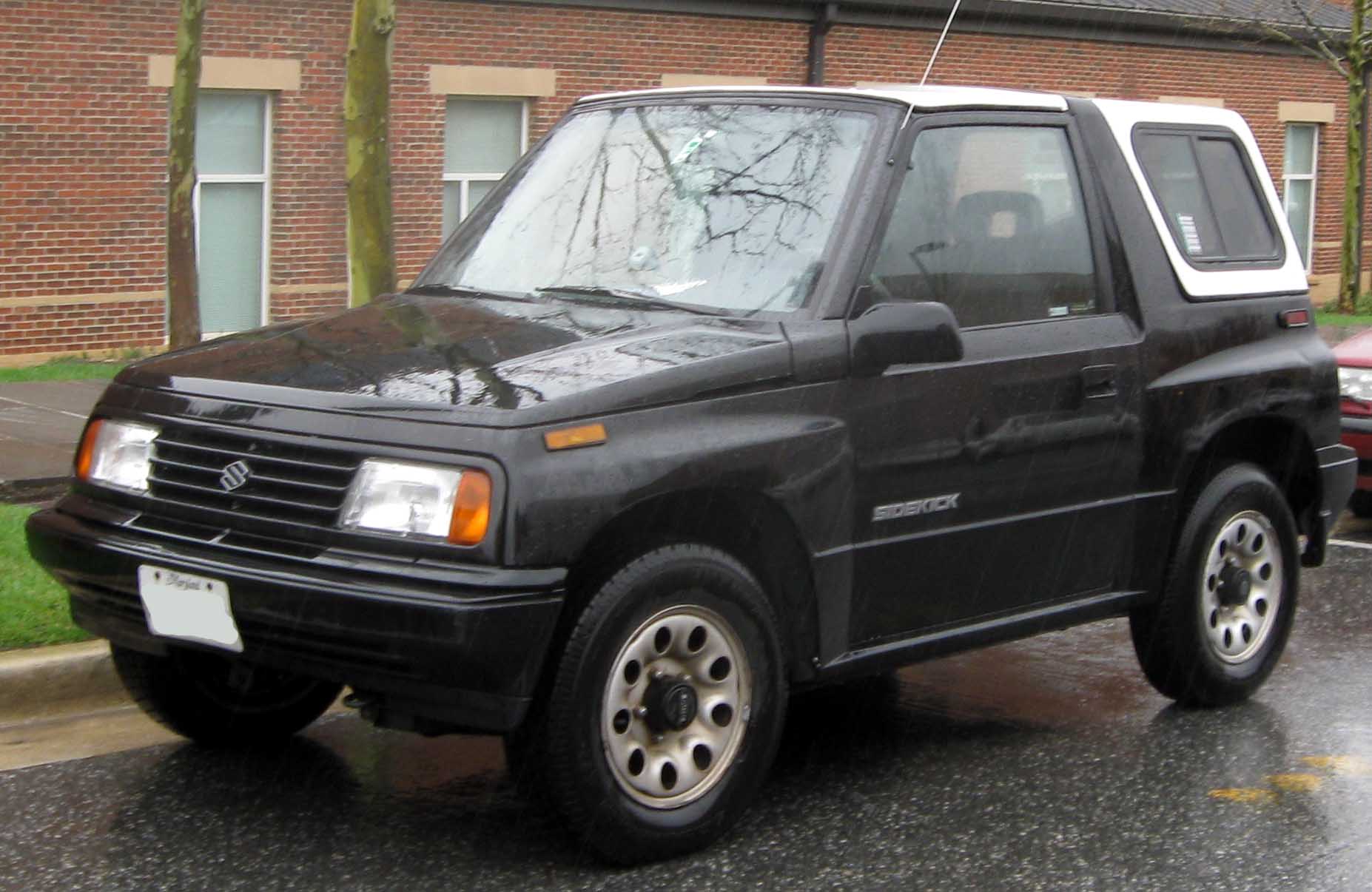
Suzuki has historically seen success in the SUV market, and this is where they should continue to focus their efforts. The Grand Vitara (and the larger and slightly uglier XL7) is based on the Chevy Equinox platform, but is altered enough so as to mask the part-sharing. This is the one Suzuki you DO see on the road because it is consistent with the company's heritage. The Vitara is the modern-day replacement for the Sidekick, which was very successful in the US, along with its rebadged sister, the Chevy/Geo Tracker.

Suzuki Sidekick
I can't say the Sidekick has held up very well over the years, but at its time, it held a dominating position in the small, fun SUV category - a more refined alternative to the Jeep Wrangler. The convertible top (now absent from the Vitara) was an appealing feature for young buyers.

So, my advice for Suzuki? Marketing is not your forte, so stop selling cars no one knows about or cares about. Scale down your partnership with GM/Daewoo, which isn't helping you. Focus on the small SUV market where you actually have brand equity, and actually create something innovative people WANT to drive. Otherwise, you will always be an also-ran, no matter who you get to design your cars (ahem...Italdesign). Selling a poorly rebadged Nissan Frontier does not fool buyers, just as selling a rebadged Dodge Dakota did not fare well with Mitsubishi.

Tuesday, July 26, 2011

My take on the Honda CR-V...past, present, and future

Honda CR-V Concept
If you read any popular car news blogs, you've probably already come across this picture "leaked" by Honda (probably on purpose) a couple days ago. This is the only picture released so far, so we haven't seen the taillights or interior. In a nutshell, I think this "concept" - which, by the way, will probably be ~95% identical to the eventual showroom model - is a huge improvement over the outgoing model, but the grille bothers me. Click through to read my impressions.


Honda Accord Crosstour
The CR-V concept's troubling grille is unfortunately borrowed from the new Crosstour. The Crosstour is probably the most unattractive and disproportionate SUV on the market today, so it pains me to think that Honda is spreading its awkward design cues to adjacent models. The Crosstour's grille is too short and angular, the rump is too big (makes the Panamera look svelte!), the stance is too low, and the price is too high for a vehicle that really can't go off road. The CR-V's more toned-down grille looks slightly better, but still...c'mon Honda!

2006-present CR-V
Let's take a look at the current CR-V. As I mentioned, the new CR-V Concept represents a significant improvement. But first a disclaimer: to any readers who own this car, I do understand why: it is very well constructed, cheap to repair, has excellent resale value, is pleasant to drive, and has ample space. I am not denying these facts at all. However, the design is a mixture of awkward curves and angles that, when combined, look fairly disjointed and convoluted. Let's start with the front end - why is there an extra grille underneath the Honda logo? It looks ridiculous and completely out of proportion. Honda facelifted the front end in 2010, but it did not solve the issue.

2006-present CR-V

Now let's move to the thick D-pillar. Besides providing poor rear visibility, the ovular rear windows look frumpy. I'm not really sure what look Honda was going for - the Jetsons? A mid-90s Ford Taurus? The new CR-V concept thankfully solves this issue with much more attractive Lexus RX-like rear windows. The ribbed plastic body-cladding along the sides, front, and rear of the car help a little bit, but I'm afraid it's not enough. One design feature that does work on this (and all) CR-Vs is the taillight design. The vertically-stacked lights are unique to the CR-V and from afar, give the rear end an almost Volvo-esque look.

2006-present CR-V
The interior of the current CR-V is quite pleasant and, similar to most Hondas, extremely well made. The position and angle of the shifter are not very sporty, but the overall fit and finish is leaps and bounds over the CR-V's American competitors.

2002-2006 CR-V
In contrast with the current CR-V, the previous generation has a fantastic exterior design, through-and-through. The front-end is simple and clean, yet rugged. The triangular-shaped C and D pillars make the car look quite strong, as if it could traverse any kind of terrain (whether or not it actually can!).

2002-2006 CR-V
The interior is also up to Honda's high standards of craftsmanship, but the design looks a bit outdated now (including the print on the cloth seats). Perhaps Honda was aiming for the rugged Land Rover / Jeep effect? If so, it worked.

1995-2001 CR-V
In the mid-90s, SUVs were a novelty; suddenly the Jeep Cherokee had competition from Japan,  namely the Toyota RAV4 and Honda CR-V. (Nissan was late to the game with the XTerra, and I would not consider the Suzuki Vitara a formidable competitor.) Compared to the first-gen Toyota RAV4, the original CR-V has held up considerably better. Whereas a mid-90s RAV4 looks squished and stilted, the first-gen CR-V still looks like it is ready to go on a safari. The proportions are excellently well-balanced - not too big, not too small. The front end is modest yet attractive, and from afar (to the untrained eye) this model could be mistaken for a Land Rover Freelander. 

1995-2001 CR-V
The original CR-V's interior is basic, yet functional and attractive. No user manual required to operate any of the switches. And look at that cassette player...nice ;)

The takeaway of this post: the CR-V has always been an steadfast competitor in the small crossover market. I think Honda lost its way in the current (2006-present) model, but the jury's still out on whether the brand new concept will regain the essence that made the original CR-V so unique. Basic is better!