Showing posts with label honda. Show all posts

Thursday, September 27, 2012

10 "hidden gem" cars I don't see enough of on the road

Cadillac CTS Coupe
I saw a Cadillac CTS Coupe in town the other day, which reminded me how well-designed it is. The wedge shape is distinct, aerodynamic, and downright sinister...love it! But I don't see enough of these cars on the road for some reason. Click through for some other examples of great cars that people should buy more of.


Lexus CT
The CT is based on the Prius but sooo much cooler looking. LED lights, an interesting computer mouse-like dashboard controller, and the Prius-like gas mileage make this car a true unsung hero. My guess is that the CT's more traditional station wagon-like roof scares people off? Americans prefer sedans and fastbacks to station wagons, which would suggest that the Prius' more sloped trunk (and lower price point) have led to its success.

Hyundai Veloster
Having driven the Veloster through Zipcar, I am an instant fan. A lot of people complain about its space-age styling, but I think that's what makes it so interesting. The hidden third door makes getting in and out of the backseat easy, while retaining the car's coupe-like looks. I haven't seen too many of these cars on the road despite its attractive price...

Honda CRZ
The CRZ channels the CRX's awesomeness of the late '80s, but with updated technology, a sleeker body, and a hybrid engine. The CRZ's two seats and evidently sluggish engine are what I believe have made it a slow seller, but it's a shame, because I thought it would be a huge hit -- the next de facto teenager car. Maybe the article I recently read saying that fewer teens are driving works against the CRZ's favor.

Buick Regal
The Buick Regal, which is based on the European Opel/Vauxhall Insignia, is one good looking car - inside and out. GM failed to bring the Opel Astra to Saturn - probably because they had to sacrifice so much of its technology for the Saturn's low price point - but the Buick doesn't have to make those sacrifices. Despite this car's awesome looks, I don't see many on the road. Hopefully younger car buyers will get over the fact that it's a Buick and see the car for what it is!

Ford Fiesta ST
I see a lot of Focuses (Foci?) on the road, but not many of the smaller Fiestas. I drove the Fiesta off-road last year and had a BLAST. It is peppy, attractive -- even more so now with the Aston Martin grille -- and uses high-quality interior materials. Owning this car doesn't make sense in rural territory, but in urban and suburban environments, it is a great alternative to the ancient Smart car or drab Yaris. Americans should give the Fiesta a chance!

Audi A3
I see many more A4 Sedans than I see A3 Sportbacks, even though the A3 has a similar engine, is cheaper, and uses many of the same interior materials. Having driven the A3 through Zipcar, it has become one of my favorite "hidden gems".

Ford Taurus
This may strike you as an odd choice, but for some reason I don't see too many Tauruses on the road. I think it is a handsome looking car, has a well-appointed interior, and is a far cry from the Tauruses of last decade. I'd like to see more on the road -- other than Police cars.

Cadillac SRX
The SRX is, for all intents and purposes, a strong contender in the entry luxury SUV market. But for some reason, I see many more Lexus RXs and Infiniti FXs than SRXs. Having driven the SRX myself, I was quite impressed by the quality of the interior, the faux-hand stitched dashboard, etc.

VW CC
The CC was supposed to be VW's attempt at knocking the Mercedes CLS off its throne at a much lower price point. While the CC arguably does not cause nearly the same emotional impact that the CLS has, it is still a looker in today's world of mostly boring midsize sedans. I see many more staidly Passats than the expressive CC. What gives?

Sunday, July 22, 2012

10 boring cars: neither attractive nor ugly

Acura RL / RLX
When Acura released images of the new RLX, I was disappointed. I think the swoopy character line on the sides is homely, and the rest of car is undifferentiated from a lot of the other midsize luxury cars on the market. The RLX made me think of some other cars that are neither good looking or unattractive, but rather boring. Click through for 10 examples.


Acura RL
1. Acura RL: As mentioned in the intro, I've never understood where the RL fits in. The design is completely dated, and could have potentially looked cutting edge 10 years ago. It's a perfectly capable car, but probably not what Acura executives would prefer to be their flagship offering.

Lexus ES
2. Lexus ES: Yawn...the ES is soooo boring. The first-generation model had cool taillights that looked like a baby LS, but the current model looks more like a tarted-up Camry than ever. The average ES-owner is probably well into retirement age (not that there's anything wrong with that!), and reviewers consistently describe how bland the ES's performance and handling are.

Audi A8
3. Audi A8: The Audi A8 is by no means ugly; in fact, it is quite handsome. However, it does not have the excitement that the S-Class or 7-Series have. The A8 is actually a fairly boxy design if you think about it. What makes the A8 work are the subtle curves, technology, and, frankly, the Audi logo. I would love to own an A8, but it is not the first car that comes to mind when I think "excitement".

Honda Pilot
4. Honda Pilot: My guess is that Honda saw the success of the Jeep, Hummer, and wanted in on the action. While the resulting Pilot is similarly boxy, it is by no means rugged or cool. It is extremely bland and devoid of character. Not ugly, just boring.

Toyota Corolla
5. Toyota Corolla: Ugh. Renting a compact car and winding up with the Corolla is like drawing the short straw. Everyone knows someone with a Corolla. They are endlessly reliable, last forever, and capable enough to handle the average person's daily commute. However, that makes the Corolla ubiquitous, and it happens to be a boring design as well! When the current generation first came out, it was stylish, but Toyota hasn't made enough changes over the years to substantially update the car, and the competition has certainly caught up.

Dodge Journey
6. Dodge Journey: Everyone's heard of the Dodge Durango, but most people haven't heard of the Journey. The interior was never up to par, but there is something too "dainty" about the exterior. I don't know what it is...maybe the chrome accents? Taking a step back, the design looks more like a minivan than a rugged SUV. It's not ugly, but falls through the cracks because of its run-of-the-mill style.

Kia Forte
7. Kia Forte: Most of Kia's current lineup is, dare I say, exciting. Cars like the Optima, Elantra, and Sportage have brought Kia's reputation to a new level. The Forte was the first car to preview Kia's new design language, but compared to the others cars I just mentioned, the Forte looks tame in comparison. It is a good design, but there is not enough going on for the Forte to resonate in people's minds. Hopefully the next model will inject some more uniqueness.

Nissan Altima
8. Nissan Altima: As I mentioned in a previous post, I don't understand the Nissan Altima. Unlike the Fusion and Sonata, both of which are beautiful designs, the Altima is blobby and disproportioned. In 5 years time, it will blend in on the highway, just like every other previous Altima has.

Scion xD
9. Scion xD: The Scion xB has always had a cult following for its boxiness. The tC is a cool coupe with lots of standard features. However, the xD makes no sense. It costs about as much as the xB, but is smaller and isn't as distinct looking. The xD replaced the xA, which also prompted the question, "what's the point?"
Subaru Forester
10. Subaru Forester: I understand why people - especially in the Northeast - get Foresters. They are good in the snow and have plenty of room to store things in the back. However, it is so nondescript. Some people call it an SUV, others (like me) call it a wagon, so it's stuck somewhere in the middle and suffers from weird proportionality.

Friday, April 20, 2012

Is the 2013 Nissan Altima attractive enough to compete?

2013 Nissan Altima

The Nissan Altima has always been third fiddle to the perennial favorites in the segment, the Toyota Camry and Honda Accord. The Altima is perfect for someone who wants a reliable, safe family car, but wants a little more sportiness and personality than the bland Camry or Accord. However, when Nissan unveiled the new 2013 Altima at the New York Auto Show, I was, frankly, disappointed. With new beautiful designs from Ford, Hyundai, and Kia, why would anyone looking for "sportiness" and "pizzazz" go with this Altima? Click through for my reasoning...


Personally speaking, I'm typically not a fan of Nissan's designs, but I admit that Nissan makes reliable, futuristic-looking cars and accordingly has a strong following. The new Altima has a lot of the same design features seen on the rest of Nissan's current lineup, chiefly the weird concave grille (Versa) and the kinked headlights and taillights (Maxima / 370Z). The wavy line on the side is mildly interesting, but it doesn't go far enough to elicit much emotion. The interior is attractive enough. Having not driven or sat in the new Altima, I can only comment on the pictures I've seen so far, and I am overall underwhelmed.

2013 Ford Fusion
In contrast, Ford surprised everyone when they unleashed the new Aston Martin-like Fusion design. Not only will this car be one of the best looking in its class, but also it will arguably be one of the best looking cars available period. Seriously, if sportiness and design are important to you, why would you buy the Altima over the Fusion? Some people may argue that Japanese quality is better, but Ford's reputation has improved quite a bit in recent years, and is probably comparable to the Japanese competitors, for all intents and purposes.

Hyundai Sonata
The current Hyundai Sonata has been around for a couple years now, but it still looks awesome. Its Mercedes CLS-like lines are almost too classy (if that is possible) for a car that costs sub-$25k. Unless you still have an (unfair) bias against Hyundai, or if styling is not important to you, I cannot understand why anyone would buy the Altima over the Sonata. And...the warranty is better too.

Kia Optima
I have real trouble deciding whether I prefer the Optima or the Sonata; honestly, I still haven't made up my mind. Both cars are so refreshingly attractive. I've driven the Optima Hybrid and was impressed by the car's dashboard, which seemingly wraps around the driver. The quality was top notch, the engine was peppy, and the exterior of the car is gorgeous.

Returning to my original point, I fail to see how the Altima competes: it is perceived to be not as good as the Camry or Accord, but doesn't have the sex appeal (interior or exterior) of the Fusion, Sonata, or Optima. And don't forget, the new Chevy Malibu will also give the Altima some added competition. I'm not sure I love the new Malibu's styling, but I think it is more harmonious than the Altima's.

Sunday, October 9, 2011

Review: Toyota Prius - the king of hybrids

 
I recently had a chance to drive the Toyota Prius through Zipcar, and it's not all bad. Here is the review, which I wrote as a guest contributor for RawAutos, an interesting car blog you should also check out. The blog owner, Josh Lewis, is a great writer, has fresh opinions, and is an all-around good guy. So do yourself a favor and check out his blog as well!

Now on with the review...

The Toyota Prius is the world’s best-selling hybrid and one of Toyota’s best selling cars…and all for good reason. It offers awesome fuel economy, a high-quality interior, and tons of trunk space. Having recently driven and reviewed the comparatively downmarket Honda Insight through Zipcar on my blog a few weeks ago, I can conclude that while the Insight is good yet slightly underrated, the Prius is rather deservedly highly rated. While I didn’t intend to make this article a battle royale between Honda and Toyota’s similar-looking 5-door hybrids, one can’t help but draw comparisons. Bottom line – the Prius is more pricey, but the driving experience is also more satisfying. Click through to see the rest of the review:


Performance: Today’s hybrids are inherently not fast cars, but their buyers are not expecting high performance, so it would not be fair of me to knock the Prius for its sluggish acceleration and annoying lawnmower-like engine whine. And for those who want to play devil’s advocate: the hybrid versions of high-end cars such as the Lexus GS/LS, Porsche Panamera, and Cadillac Escalade may be fast AND sound decent, but I would not consider these vehicles hybrids in the truest sense given their paltry improvement in fuel economy. Simply put, the Prius is slow; its power feels similar to compact cars such as the Corolla, Civic, and Sentra, despite offering midsize-like space. While the Prius feels no faster than the Insight, it somehow manages to corner better and drive livelier. Engine-shutoff is a smoother process in the Prius, as I experienced much less “jolting” than the Insight at stop lights. Regenerative braking in the Prius, as in all hybrid cars, takes getting used to as it is much more responsive than in regular cars.


Exterior Design: Despite having nerdy hybrid-like characteristics, I still think the Prius is a fresh, unique, respectable looking design. The overall exterior design, especially the side profile and rear end of the Prius, is marginally sleeker than the Insight. I also prefer the Prius’ design to just about every other Toyota model, especially the bland and ubiquitous Camry, Corolla, and Highlander. I must admit that the Toyota Prius’ front end is too blobby for my taste, and I prefer the more futuristic fascia of the Insight. The bump in the center of the Prius’ hood near the Toyota logo reminds me too much of the Yaris, and the headlights look like the nonsensical shape of the Nissan Z and Maxima’s headlights. The Prius’ LED taillights, blue halo effect around the Toyota logo, kinked D-pillar, and glass inserts between the A-pillar and side mirrors are thoughtfully designed features that make the Prius stand out. The Zipcar logos all over the trunk and right side made my Prius even more of a head-turner!


Interior Design: The interior is really where the Prius leapfrogs over the Insight, as its design is considerably more ergonomic and thoughtful. The Prius’ marketing strategy is quite paradoxical: buyers are generally eco-friendly, so the car couldn’t be too luxurious, but at the same time, the Prius needed enough creature comforts to appease the wealthy buyers and celebrities who, truthfully, are likely more attracted to the Toyota Prius for the mere appearance of eco-friendliness. I believe Toyota has struck this balance perfectly, which is why the Prius has been a hit, and the more basic Insight has faltered.

The Prius’ dashboard is pleasingly laid out; it almost feels like it is curled around the driver, waiting for his or her next command. I love the design of the center air vents – the chrome accent in the middle and the downwardly curled edge on the left side are tastefully executed. The center radio / air conditioning console is covered in an appealing ridged plastic that gives a convincing appearance of metal. Overall, the layout and materials used on the dash are considerably higher quality than the Insight. The thinness of the console reminds me of Volvo’s beautiful interiors, maximizing storage space behind the console. Its dashboard buttons are simple to operate (I was driving a fairly base model, but navigation is an available option). I usually don’t like cloth seats, but the fabric on the Prius’ seats was very soft and tastefully crafted. The Prius’ high-quality dashboard plastics are imprinted by a mix of soothing wave-like patterns – a small touch that actually put a smile on my face.
 
There are a number of features that make driving the Toyota Prius an “experience” and reminded me that I was driving a hybrid-electric car. The start button is a much-welcomed feature that is not found on many cars at this price point. The shifter is an interesting Star Trek-like joystick that glides to Drive and Reverse with a flick of the wrist, and it is much more pleasing to operate than a standard shifter. When you’re ready to park, you press a button rather than shifting the joystick. There are also buttons to change the source of power from pure electric to a fuel sipping “Eco” mode to a more gas-hungry “Pwr” mode for those late for work. However, I think these buttons are somewhat unnecessary given how efficient the car is in its normal setting. The Prius’ steering wheel is intelligently designed with convenient buttons to operate the radio. When you press a button, an identical image of the button simultaneously appears next to the speedometer – an upmarket feature that reminds me of the heads-up displays found in Cadillacs and BMWs.

A couple gripes with the interior: while the little image of the Prius showing the car’s source of power is nifty – and I could see it being important to fuel-conscious buyers – I do prefer the Insight’s blue / green color-coding that indicates when the driver is using gas vs. electric power. Toyota should implement this feature in the next redesign. I also despise the central location of the speedometer. I never like centrally mounted speedos. Ever. It is extremely distracting to continually look away from the road to see how fast I’m going. I didn’t like this design concept on the Saturn Ion, Mini Cooper, or Scions, and I don’t like it here. Lastly, the color of the interior is an overwhelming gray color – the two-tone option looks better, but regardless, the interior could be spruced up with some wood accents carefully placed on the dash and door handle areas.


While the design of the Toyota Prius is quite unique and screams “HYBRID” to the world, it is also very practical. There is plenty of room for large cargo, especially when the seats are folded down. The first-gen Prius was a relatively dorky-looking compact sedan with a traditional amount of cargo space. The latest body style solves this issue and is much more relevant for families and small business owners who frequently haul large objects.


Conclusion: The Prius is a mass-produced masterpiece, and in the world of hybrids, it is king. However, if I was in the market for a mid-$20k 5-door, I would never buy a Toyota Prius or a Honda Insight… I would buy the Audi A3 because I (and likely you, a car blog reader) am not the Prius’ target buyer. The Prius and Insight are devoid of performance, solely existing to be ecologically and economically responsible and, as a result, take the fun out of driving. In fact, while I was taking pictures of the Toyota Prius, I was quite distracted by a beautiful Porsche 911 Targa that drove by. When a car company produces a reasonably priced, quick, fun-to-drive, practical hybrid with Prius-like mpg stats, only then I’ll be interested. And a 20 mpg Escalade Hybrid doesn’t count. But for non-car enthusiasts, the Prius (and for those on a tighter budget, the Insight) is the perfect choice – fuel economy, an eco-friendly image, cargo space, and all the standard creature comforts.


[Photo credit: Toyota]

Tuesday, September 20, 2011

Why does Suzuki still sell cars in the US?

Suzuki Equator
I like to think that I keep up with the car industry, but I had NO idea Suzuki sold the Equator pickup...let alone the fact that they have been selling the truck since 2009! I have never EVER seen one on the road. This lazy excuse of a Nissan Frontier rebadge is exactly why Suzuki has had trouble gaining traction in the US in the last 20 years. Most of Suzuki's cars have been sourced from other automakers, notably through its partnership with GM/Daewoo. Unless it changes its strategy, I give the Suzuki US brand another 5-10 years before going the way of Isuzu -- that is, extinct. Click through to read why...


Suzuki Swift
Let's start by discussing Suzuki's smallest offering, the Swift, which is not sold in the US, but should be. For all intents and purposes, this is a perfectly competent car: reasonably attractive, sporty, and has competitive interior materials. Suzuki has likely resisted bringing the latest-gen Swift to the states for a few reasons: 1) an inability to effectively market its brand, 2) historically soft subcompact sales in the US (until recently) and 3) the troubled past of the Swift name. When I think of the Swift, I instantly think of the lazily rebadged Geo/Chevy Metro, one of the ugliest, most pointless subcompacts ever to hit US dealerships...

Second-gen Suzuki Swift (aka Geo Metro)

Does this picture ring a bell? None of these cars have held up over time, including this ripe example.  The new Swift is not rebadged at all, but Suzuki would need to change the name to give the car a fresh start.

Suzuki SX4 / Liana
The SX4, formerly known as the Aerio, is also known as the Liana in other parts of the world. This car was co-developed by Fiat and was designed by Italdesign Guigiaro, so it definitely has the right ingredients for a winning design. The SX4 also has had a successful run in the rally circuit. In addition, over the last 10 years, the Liana/SX4 has been featured in Top Gear as the Star in a Reasonably Priced Car both in the UK and US. Despite all this, I rarely see SX4s on the road, which I believe is the result of weak consumer marketing. Buyers of cheap compacts cars aren't necessarily watching Top Gear and WRC races. I also don't like the odd piece of glass between the A-pillar and door frame, which makes the car look cheap.

Suzuki Forenza
The now-defunct Forenza sedan / Reno hatchback, also designed by Italdesign, is a pair of reasonably attractive cars also sold under a plethora of names around the world, ranging from the Chevy Lacetti (as seen in the UK Top Gear), Holden Viva in Australia, Buick Excelle, Daewoo Nubira, and a variety of other names. After Daewoo left the US as an independent brand, its parent GM decided to pump their econoboxes through every partner and sub-brand possible, and the US got the Suzuki Forenza. At the end of the day, poor marketing killed the success of this bland yet competent car.

Suzuki Verona
The Verona, also now defunct, was another forgettable Italdesigned GM/Daewoo concoction, competent but not relevant enough to compete with the Camry, Accord, etc. If GM felt so highly about this design, wouldn't they have used it in place of their Malibu / Impala? The truth is, they didn't, so they gave the Verona to Suzuki to sell. Its success was miserable.

Suzuki Kizashi
Starting to see a trend? The Kizashi is Suzuki's replacement for the unmemorable Verona. It consistently performs well in comparison tests, but you see none on the road because of lack of marketing (and probably because of that ugly Lincoln Continental-style hump on the trunklid...ugly!). The front end, side profiles, and interior of the car are attractive, but I don't anticipate this car being successful enough to make a compelling business case in the US.

Suzuki Grand Vitara
Suzuki has historically seen success in the SUV market, and this is where they should continue to focus their efforts. The Grand Vitara (and the larger and slightly uglier XL7) is based on the Chevy Equinox platform, but is altered enough so as to mask the part-sharing. This is the one Suzuki you DO see on the road because it is consistent with the company's heritage. The Vitara is the modern-day replacement for the Sidekick, which was very successful in the US, along with its rebadged sister, the Chevy/Geo Tracker.

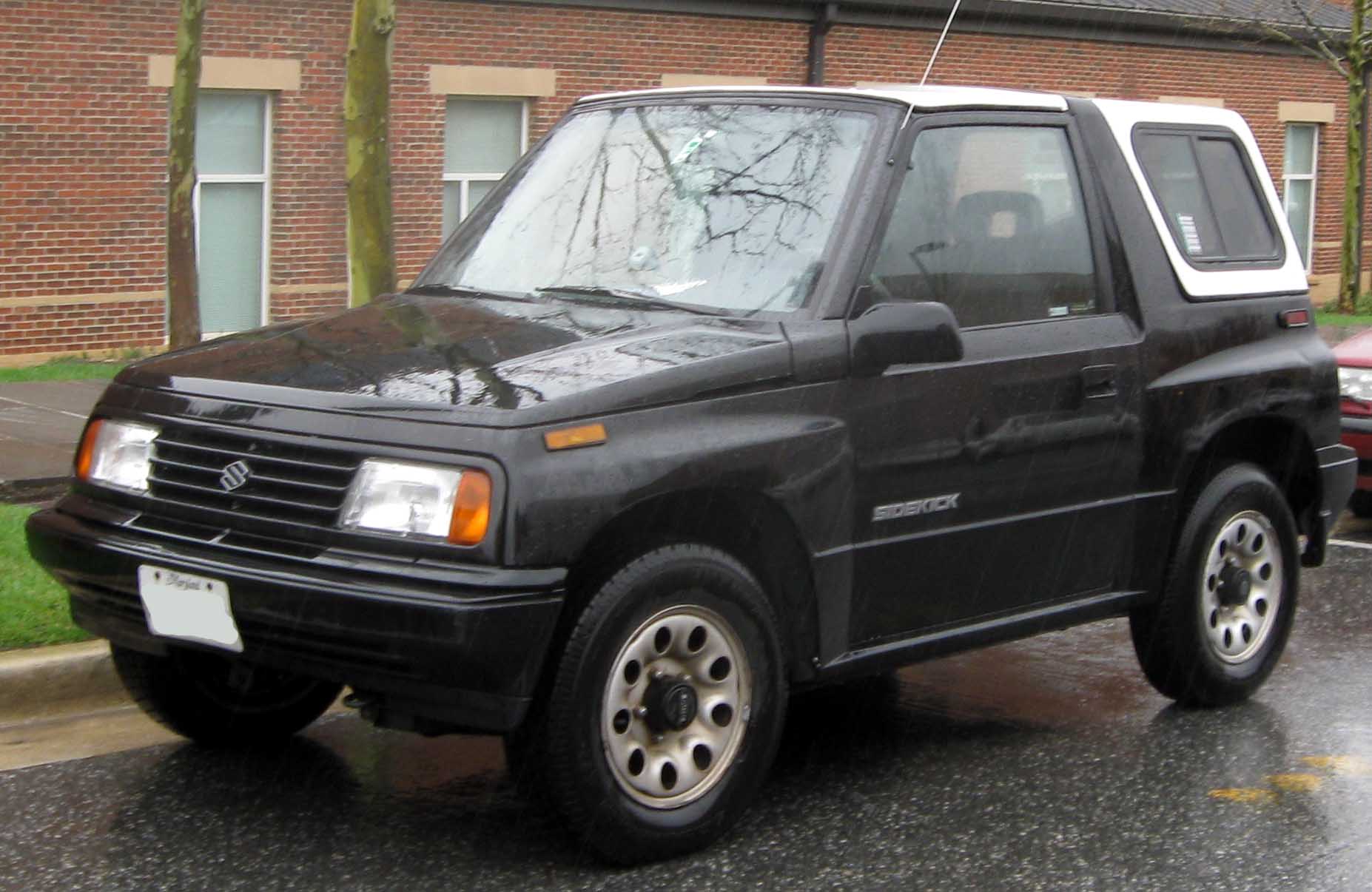
Suzuki Sidekick
I can't say the Sidekick has held up very well over the years, but at its time, it held a dominating position in the small, fun SUV category - a more refined alternative to the Jeep Wrangler. The convertible top (now absent from the Vitara) was an appealing feature for young buyers.

So, my advice for Suzuki? Marketing is not your forte, so stop selling cars no one knows about or cares about. Scale down your partnership with GM/Daewoo, which isn't helping you. Focus on the small SUV market where you actually have brand equity, and actually create something innovative people WANT to drive. Otherwise, you will always be an also-ran, no matter who you get to design your cars (ahem...Italdesign). Selling a poorly rebadged Nissan Frontier does not fool buyers, just as selling a rebadged Dodge Dakota did not fare well with Mitsubishi.

Sunday, September 18, 2011

Honda Insight review: why does it get such a bad rap?


The car I was driving in my previous post on the Ferrari 458 was the Honda Insight, one of my favorite Zipcars because of its lower hourly cost compared to gas-powered cars. While the Prius is overall a better car than the Insight, there are many things I actually like about the Insight. Contrary to just about every review out there, I actually don't mind driving the Insight. Click through to see my impressions:


In a number of ways, the Honda Insight is very similar to the Toyota Prius, especially from the side profile. The original Insight from the late-'90s was the first mainstream hybrid to hit US dealerships, even before the Prius. It was a weird-looking 3-door hatchback that looked like it needed training wheels. Honda attempted to make the car as aerodynamic as possible, and in the process, probably alienated certain prospective buyers. However, in the latest iteration, the Insight looks mainstream, yet refreshingly futuristic.

The front end looks great - more so than the more bland-looking Prius. The traditional 3-bar Honda grille, which looks ghastly on the Crosstour, looks much better on the Insight. The plastic around the headlights has an interesting blue tint that adds to the car's mystique.

Compared to the Prius, the Insight accelerates slower, but neither car is fast by any means. The Insight's engine sounds like a lawn-mower and accelerates at only one speed - slow. However, you're not buying a 5-door hybrid for performance; you're buying it for gas mileage, status, and for the environment (all worthy causes in my book). The Insight's regenerative braking is an awesome idea that all cars (including gas-powered ones) should have, and it makes for fairly responsive braking.

I was disappointed by the crummy plastic hubcaps, which can't be very aerodynamic. The original Insight had distinct flat alloy wheels that appeared to easily cut through the wind.

The Insight's interior does not have the fit and finish of the Prius, but it is also priced lower than Prius. The layout is much simpler and filled with hard plastics, but the dashboard is pleasantly contoured, similar to the Honda Fit and now-defunct Acura RSX. If you keep in mind that the Insight targets economy hybrid buyers, it isn't so bad.

Simple yet trendy, the Insight's radio and A/C controls are easy to figure out and look appealing. This base model does not have the trademark computer screen the Prius has, but who needs that anyway? It only adds to the sticker price.

One thing I love about the Insight (and Civic Hybrid) dashboard is the little blue light surrounding the speedometer, which turns green when you are using the electric motor (i.e., when you lift off the gas or hit the brakes). For me, driving the Insight becomes somewhat of a videogame to keep the light green as long as possible, especially given the inherent lack of power in the engine.

The final comment I would make is how practical the Insight is. I had to buy some large pillows and bedding and the Insight easily fit the large packages in the spacious trunk. The only problem with the design of the Insight (and the Prius) is that the spoiler cuts right into my rearview visibility. Otherwise, I think this 5-door hatchback is a great design concept. Overall, I would definitely consider buying the Insight if I was looking for a hybrid given its lower price point, intelligent color-coded dashboard, spacious trunk, and scarcity value - you don't see as many on the road as the relatively ubiquitous Prius, so the Insight is much more of a head-turner.